
Independent Publisher of Considered Non-Fiction
Essays
By Sam Farah
Published in Edge by the Institute of Leadership, UK, April 2026

Grace Under Pressure:
The Myth of the ‘Naturally Calm’ Leader
Some people, we say, are simply wired to be calm under pressure. They stay composed, make clear decisions and steady those around them. And sure, some individuals do have a natural advantage in high stress situations, but mistaking calm performance for innate temperament is one of the most persistent and damaging myths in leadership.
The myth of the naturally calm leader does real harm because it excuses poor behaviour by framing it as temperament (“that’s just how they are under pressure”). It leads organisations to over-value visible confidence while under-investing in teachable skills. And it discourages capable professionals from seeing themselves as leadership material because they don’t believe they have the “right personality”.
In reality, what we usually interpret as calm leadership is far more about performance than it is about personality. It is the visible outcome of invisible work, done long before the pressure arrives.
I should know. I was one of those who were often mistaken for a “naturally calm leader”.
During my years leading BBC News teams across the Middle East and North Africa, pressure was not an occasional visitor; it was a constant. Breaking news, security incidents and intense political scrutiny were part of daily life. In those moments, I was rarely improvising or relying on my inherent calmness. I was drawing on communication disciplines that had already been built, and a reputation that I have consciously cultivated for calmness. The reputation does matter because it influences how much tension a leader is able to take out of a situation even before they open their mouth.
I am in not alone in leaning on performance over personality and projecting a “borrowed calm” that I don’t entirely feel inside. Most leaders do, because it is simply more efficient. Behaviour is easier to change than temperament. A competent leader who is naturally calm in a crisis will not necessarily perform better than a competent leader who has worked hard on acting composed under pressure. They would have both done the groundwork of knowing how decisions would be made in a crisis, who was empowered to act, and what “good enough” looked like when perfection was impossible. And it is that groundwork that helps sustain the appearance of calm composure which is then cascaded down the ranks.
Grace under pressure is not a character trait to be admired from a distance, but a set of learnable behaviours. A crisis does not reveal leadership as much as it exposes it. And what it exposes is usually not nature, but preparation.

By Sam Farah
Published in Medium.com, March 2026
When Your Identity Shapes How You’re Heard
The Impact Of Who You Are On Your Career
I’ve seen repeatedly how generally strong communication can land very differently depending on who is speaking, even before they’ve had a chance to prove themselves. We can pretend this has nothing to do with identity, stereotype, culture, accent, or religion. But in practice, it often does. So why does this gap exist between skill and perception? Why aren’t good communicators always recognised as such?
One reason is that communication is never judged in a vacuum. We’d like to believe that people evaluate words and ideas objectively, but in reality they interpret them through layers of expectation. Those who have ever fallen outside of their environment’s expectations will immediately recognise this.
Every workplace has an unspoken template of what the unspoken cultural expectations are. They may be linked to accent, tone, cultural style, or even personality traits that happen to align with the dominant culture of the organisation or particular environment. When someone fits that template, their message often feels immediately familiar and credible. When they don’t, the same words can be received with hesitation, or worse.
This doesn’t mean the listener is consciously biased. Much of it happens automatically. Our brains use shortcuts to interpret signals quickly: confidence, authority, warmth, competence.
But those signals are often filtered through cultural assumptions about who typically embodies them.
Accent is often cited as an example. On the one hand, research consistently shows that speakers with accents perceived as “standard” (for a particular environment) are more likely to be rated as credible or competent, even when the content of what is being said is identical to others’. But it’s not always that straight forward. As long as it’s fairly clear, a foreign accent can also be received positively, either because it shows skill, is linked to a positive stereotypes, or is simply seen as “cute”. Either way, an accent may well have an impact on how your communication is received.
I believe that cultural communication styles play a much bigger role. In some workplaces, directness signals confidence. In others, it comes across as aggressive. Some organisations or bosses tolerate open challenge, others prefer a more subtle approach. A communicator who has learned one style may suddenly find that, in a different environment, their strengths are interpreted differently.
Identity, in other words, can act as a lens through which your communication is evaluated.
These differences are rarely written into company policy, yet they shape careers and reputations all the time.
Perception Awareness
Understanding this dynamic changes how we think about communication. It suggests that communication skill alone is not always the whole story. There is also Perception Awareness: the ability to recognise how context, expectations and YOUR IDENTITY influence how messages are received.
Here’s a challenge: Find someone you really trust, and who is in a position to be aware of how your workplace communication is landing. And ask them! You won’t necessarily build your entire communication strategy on their view, but it will at least help you form your own Perception Awareness.
For some professionals, particularly those navigating cultural, ethnic, or religious difference in the workplace, this awareness becomes part of the communication strategy itself. Not as a way of abandoning identity, but as a way of understanding the environment in which that identity is being interpreted.
I’ve seen first-hand how being perceived as the “wrong” communicator can shape careers quietly but significantly. A reputation is formed. For many, the frustration this creates can slowly erode confidence, sometimes leading to defensiveness and even aggression which, in turn, further undermines how they are perceived. And once that reputation is established, well, it can be hard to shift, although certainly not impossible.
Can good communicators overcome these perception challenges and thrive with the right communication skills and without abandoning their core identity? Of course they can. But great communication without Perception Awareness often isn’t enough.
By Sam Farah
Published in Psychology of Workplaces, Oct 2025

Your Career Rises or Falls on This Skill
Why You’re Stuck While Others Advance
At the start of my 30 year media career, I was of the belief that hard work, talent and expertise would naturally lead to success. And, for a time, they did, if only within the limitations of my small team at the BBC. But, as I climbed the career ladder, I began to notice a recurring pattern: Some of the brightest and most skilled professionals around me (even among the news pros) were being overlooked for promotions, recognition or leadership opportunities.
Meanwhile, those with better communication abilities seemed to thrive, even if they weren’t more talented at their jobs.
That’s when I realised the hard truth: No matter how good your job-specific talents are, career progress without strong communication skills is incredibly difficult. Communication is the bridge between your potential and your success. It may not always be fair, but it is almost always true.
Whether you’re just starting your career or looking to move into a leadership role, talent alone won’t get you noticed, and hard work without visibility can still stall your career. Communication is the key to building influence, earning respect and achieving your career goals. And it is NOT only about improving your basic communication skills. It’s much more than that.
This isn’t just my experience. The data tells the same story. The American National Association of Colleges and Employers (NACE) published a landmark report showing that 75% of long-term job success is down to soft skills like communication, with only 25% attributed to technical abilities. And hiring managers have noticed the shift. In a study by Inside Higher Ed, 93%of employers said communication mattered more than a candidate’s academic major. And it doesn’t stop once you’re in the role. A LinkedIn Global Talent Trends report found that 94% of talent professionals believe employees with strong soft skills are more likely to get promoted.
For leaders, there is also a significant payoff:
Teams that communicate well are 50% more likely to retain employees.
72% of business leaders say that clear communication boosts productivity.
Emotional intelligence plays a key role in all of this. Multiple studies show that EQ enhances decision-making, collaboration and stress management. And professionals who combine emotional intelligence with strong communication skills are consistently rated as more credible, promotable and effective leaders.
Even our early careers are shaped by communication. In the UK, 37% of young adults are reported to lack adequate workplace communication skills, with those receiving mentoring and communication support earning up to 15% more than their peers. In Australia, communication is the number one skill required across job ads; it’s listed three times more often than the next closest skill (teamwork).
And in a 2024 survey by McKinsey, senior executives ranked communication as the top differentiator for leadership readiness, surpassing analytical and technical skills.
These aren’t just stats. They’re a clear signal. If you want to grow, lead or pivot in your career, the ability to communicate effectively isn’t just a “nice-to-have”. It’s a core skill, tightly linked to opportunity, performance and progression.
Now The Good News.
Good Emotional Intelligence skills are learnable. And for the professionals among us whose personalities lean towards introversion, relax. Mastering communication doesn’t mean being the loudest voice in the room. And it’s not only about the basic skills either (Verbal, non-verbal, listening etc..). Far from it. It’s about using clarity and emotional intelligence to build trust and quiet authority. These are the skills that will empower you to unlock opportunities, overcome challenges and create meaningful connections.
By Sam Farah
Published in Medium.com, October 2025
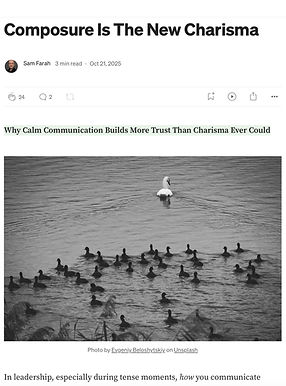
Composure Is The New Charisma
Why Calm Communication Builds More Trust Than Charisma Ever Could
In leadership, especially during tense moments, how you communicate matters just as much as what you say. I’ve always tried to lean on one quality that, time and again, proved its value: Calm Competence.
This is not about being emotionless or unshakable. It’s about being the person others look to when things are uncertain, simply because your presence suggests “We’ve got this”. During my own career, I noticed how powerful this calmness in communication could be. It reassured teams, helped defuse tension and gave people the space to breathe and focus.
Research supports what many leaders discover through experience: calm communication builds trust faster than charisma or technical brilliance. A 2018 study by the Center for Creative Leadership (Pressure Cooker Confidence. Greensboro, North Carolina, CCL Press) found that leaders rated as “composed under pressure” were rated highest for long-term effectiveness, regardless of industry. Calmness, in other words, is not just a personal trait but a visible leadership asset.
“Calm communication builds trust faster than charisma or technical brilliance”
One news executive I worked with described how this played out for her: “I used to think people needed to see how hard I was working, so I spoke quickly and filled the air with details. The moment I slowed down and left space, I could feel that my team’s confidence in me doubled. They saw focus where before they had seen stress.” Her story shows how calm is often less about suppressing emotion and more about what others perceive.
Not everywhere in the world is the same though. Culture also shapes how calm competence is read. In Japan, measured silence may signal authority, while in the United States it can sometimes be mistaken for hesitation unless paired with clarity. In Middle Eastern contexts, projecting warmth and calm together often carries more weight than a purely detached composure. Understanding these nuances allows you to adjust without compromising authenticity.
Projecting Calm Competence in High-Stakes Situations
1. Stay Calm When It Matters Most
Pressure doesn’t just test your ability to lead. It also tests how well you project steadiness. People notice your tone, body language and pacing more than they notice your perfectly crafted sentences.
Here are a few things that make a difference:
-
Keep your voice steady. Not slow or robotic – just measured. A calm tone influences the emotional temperature of the room.
-
Mind your posture and gestures. No need to overthink it; just avoid restless movements and hold your space. Eye contact, nods of understanding and reassurance and deliberate movements signal confidence.
-
Be brief but not blunt. The less processed your message, the better it will land. Clarity under pressure gives people something to hold onto.
This means being intentional, not cold or clinical. Calm communication sets a tone that others often follow.
2. Respond Thoughtfully; Don’t React Instinctively
One of the biggest shifts I’ve had to learn – and help others with – is the difference between reacting and responding. Reactions tend to be quick, emotional and sometimes regrettable. Responses are about taking a breath. They give you room to choose your words and focus the conversation.
A few habits that help:
-
Pause before speaking. Even two seconds can change the tone of a conversation. It gives you authority, and people can feel it.
-
Name what’s happening. Try saying, “I can see this is frustrating”, or, “That’s a fair concern”. You don’t need to fix it in that moment. Just acknowledging it shows awareness.
-
Redirect towards action. Calm leaders don’t stay stuck in the problem. They say, “Here’s what we can try next” and help people shift gears.
Calm competence isn’t passive, and it doesn’t just steady others. It regulates the emotional climate around you. It’s a signal that helps others think clearly and act with trust. And equally important, it makes you stand out and positions you for progress.